17 Jun Best Cupping Certification for Athletic Trainers | Offline & Online Cupping Course 2026 – Hands-On
Cupping Certification for Athletic Trainers: Quick Answer
Cupping Certification for Athletic Trainers is specialized training that teaches sports medicine professionals how to use therapeutic cupping and myofascial decompression techniques to support athlete recovery, soft tissue mobility, sports rehabilitation, and performance recovery programs.
Courses typically include practical training, safety protocols, sports injury recovery applications, and athlete-specific treatment strategies.
If you’re an athletic trainer, sports therapist, physical therapist, or rehab specialist looking for a cupping therapy certification that’s practical and built around real athlete cases — this page covers the course, who it’s for, what’s included, and how to enroll online or offline in Hyderabad India.
Athletes don’t usually complain when they’re winning.
They complain when recovery slows down.
A hamstring that won’t loosen up. A shoulder that stays stiff after training. Heavy legs before a big match.
If you work with athletes, you’ve seen this. Probably every week.
A while back, a college strength coach joined one of our offline batches here at Alhadiv Hijama Centre. He’d been using foam rollers and percussion guns on his athletes for years. Solid technique. Real care. But some athletes just weren’t recovering the way they should.
By day two of the course, he said something that stuck with us: “I didn’t realize how much of this tightness was fascial, not muscular.“
That’s the shift. Cupping doesn’t replace what you already know — it adds a layer most trainers never get taught in school.
That’s exactly why more athletic trainers, sports medicine professionals, and rehabilitation specialists are looking for a proper cupping certification for athletic trainers — not a one-day workshop, not a printout certificate — but training they can actually use.
Why Athletic Trainers Are Adding Cupping to Their Toolkit
Sports medicine has moved way past “ice it and rest.”
Athletes want faster turnaround between sessions, less soreness, and better mobility heading into competition. Recovery modalities for athletes have grown a lot — and cupping fits right in.
Here’s our honest take on it: cupping isn’t magic. It doesn’t fix everything. But for fascial tightness and soft tissue restrictions that don’t respond to regular massage or stretching? It fills a gap that most trainers don’t have another answer for.
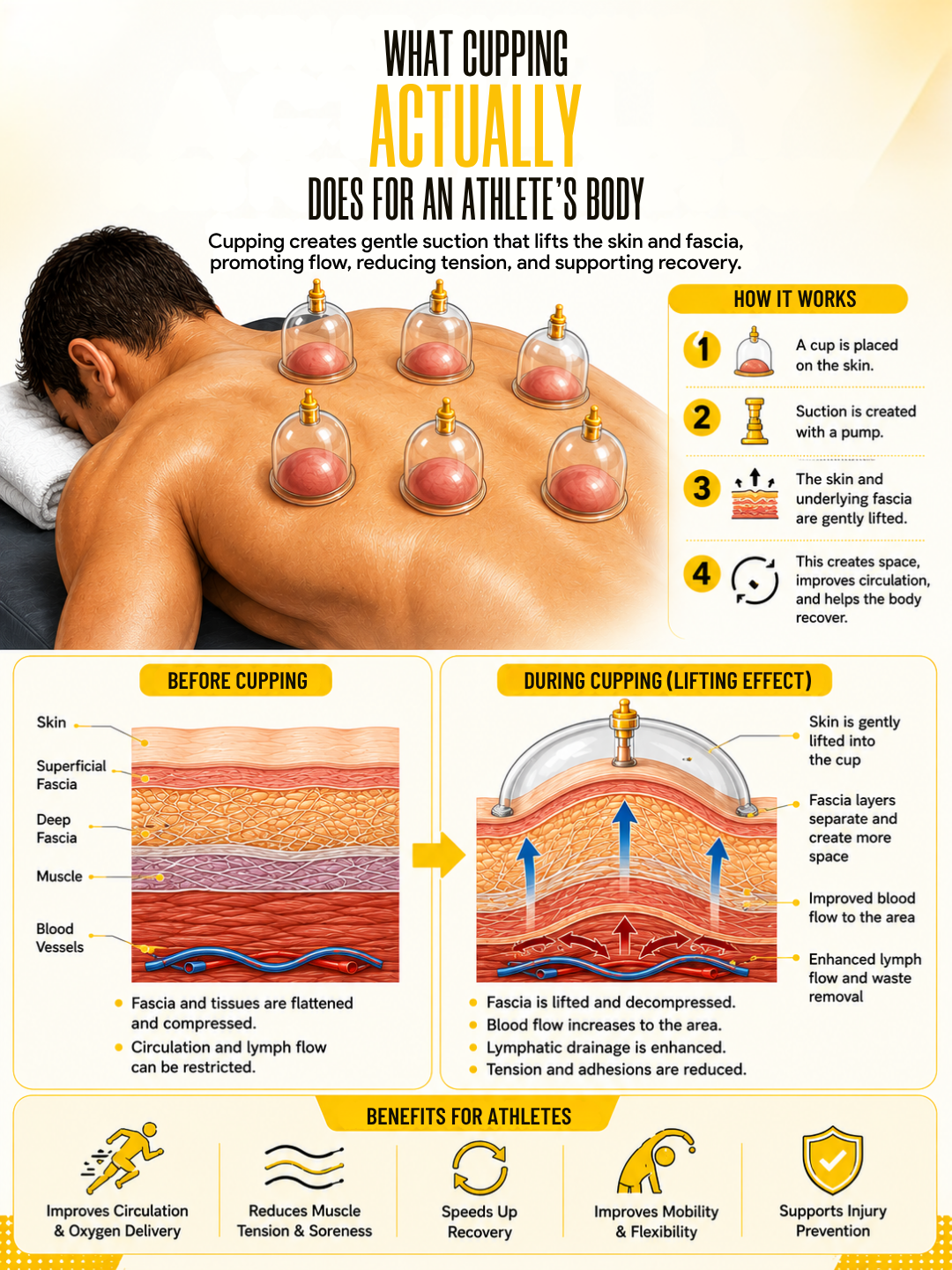
Cupping works on the fascia — the connective tissue layer around muscles. When fascia gets tight or stuck (a fascial restriction), it can limit movement, slow recovery, and feed into repeat injuries.
Myofascial decompression — the clinical term for therapeutic cupping — lifts and separates those tissue layers, increases local blood flow, and supports soft tissue mobilization.
For athletic trainers, that means:
- A hands-on tool for muscle recovery therapy that pairs with massage and stretching
- Another option for trigger point therapy when normal pressure work isn’t cutting it
- A way to support movement restoration after heavy training blocks
- One more recovery modality for athletes, backed by growing clinical interest
- A practical addition to your existing athletic training techniques — without needing a full equipment overhaul
Why Athletic Trainers Are Learning Cupping in 2026
Recovery has become a bigger focus than ever.
Sports academies, performance centers, and rehabilitation clinics are investing more in recovery modalities for athletes.
Athletes now expect:
- – Faster recovery
- – Better mobility
- – Individualized recovery plans
- – Evidence-based recovery methods
That shift is one reason sports cupping certification and myofascial decompression training continue to grow among sports medicine professionals.
What Cupping Actually Does to an Athlete’s Body
Before getting into the course, here’s what’s actually happening under the skin.
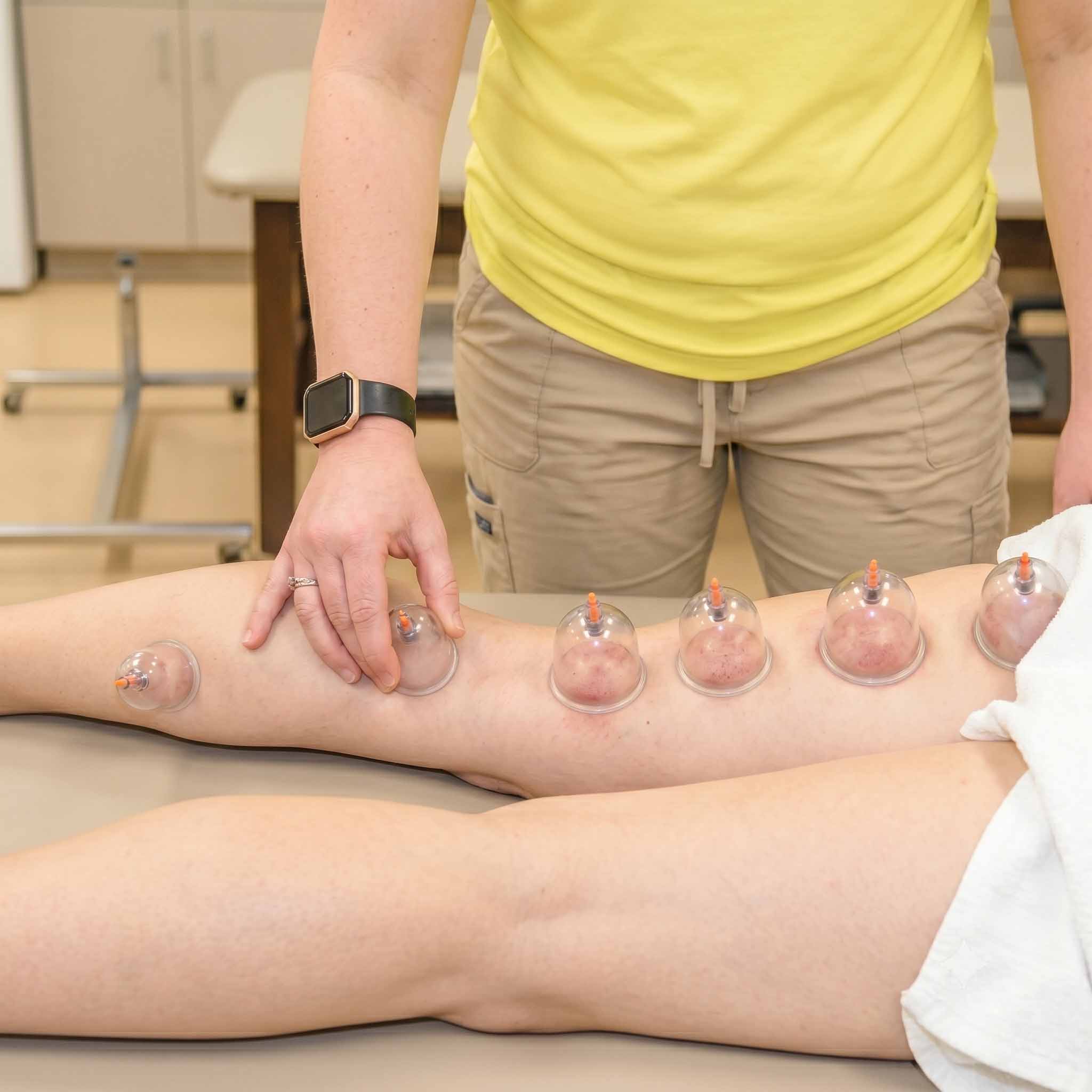
When a cup sits on the skin and suction is applied, it pulls the top layers of tissue away from the muscle below. This does a few things:
- Increases local blood flow — which can speed up muscle recovery therapy
- Releases tension in tight fascia — supporting fascial restriction treatment
- Stimulates the nervous system in a way that may reduce pain signals — useful for pain management techniques
- Creates space between tissue layers — the core idea behind soft tissue mobilization
Athletes usually describe it as a “deep stretch” rather than pressure. For trainers, this gives you a tool that works differently than a massage gun or foam roller. And for some athletes — especially those with chronic tightness — it works where those tools haven’t.
We think that’s a meaningful difference. Compression-based tools push down. Cupping lifts. That’s not better or worse across the board — it’s just a different mechanism, and having both in your toolkit matters.
Why Learn Sports Cupping at Alhadiv Hijama Cupping Academy ?
Many hijama cupping courses teach techniques.
Our goal is different.
We teach athletic trainers how to apply cupping inside real recovery programs.
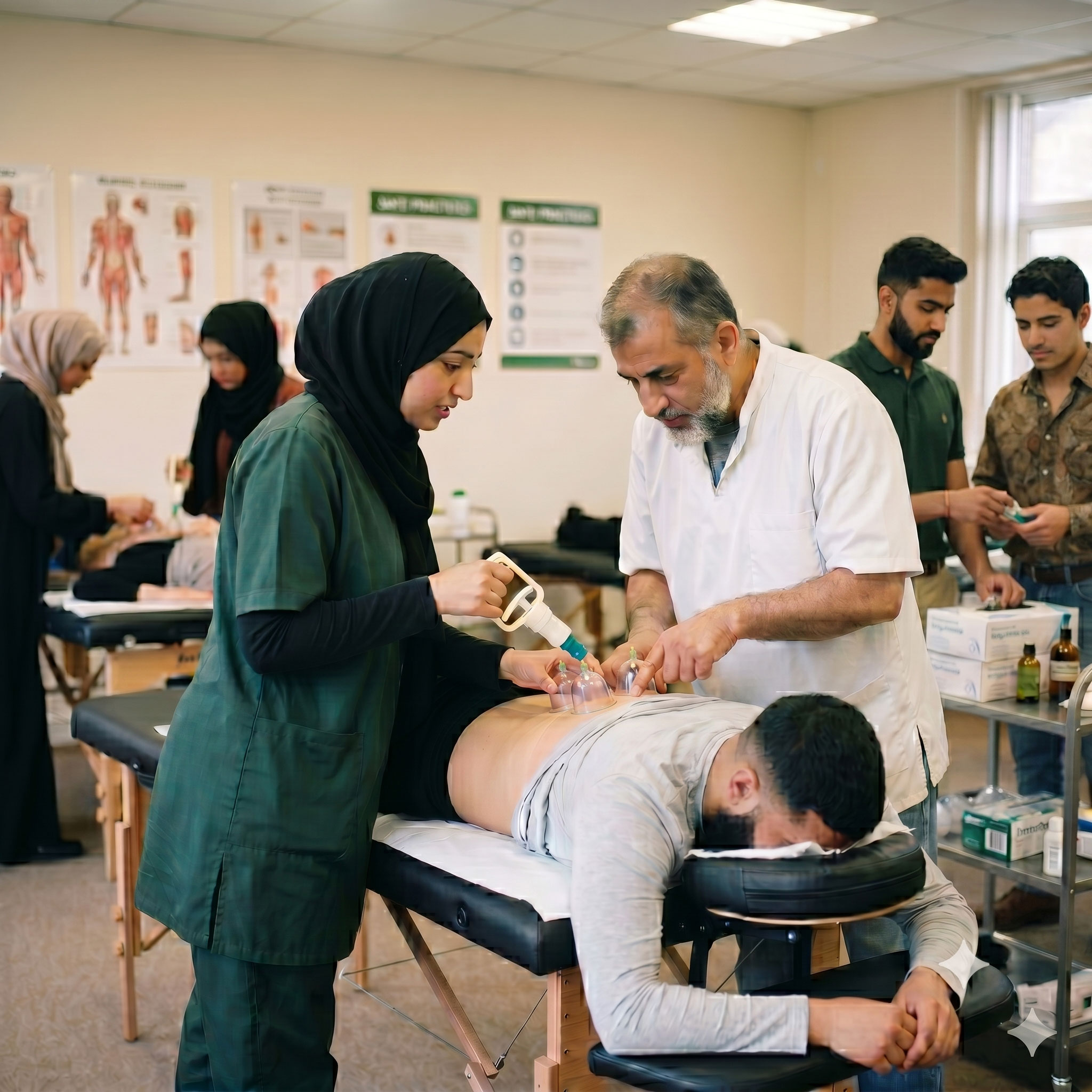
Students train with practical athlete scenarios, sports injury recovery examples, and myofascial decompression protocols they can use immediately.
Why students choose Alhadiv:
- ✓ Athlete-focused training
- ✓ Small practical batches
- ✓ Post-course support
- ✓ Sports recovery applications
- ✓ Established Hijama Centre in Hyderabad India
- ✓ Online and offline certification pathways
- ✓ Real client case discussions
- ✓ Ongoing practitioner support
Since opening our Hyderabad Telangana center, we’ve trained students from sports academies, physiotherapy clinics, chiropractic practices, and strength coaching facilities.
What Makes This One of the Top Cupping Certifications for Athletic Trainers?
Here’s the honest answer — most cupping courses aren’t built for sports.
They’re adapted from spa or wellness training, with a few athletic examples dropped in. Alhadiv’s program was built the other way around — starting with how athletic trainers actually work, what sports medicine professionals need, and what athletes respond to.
What makes this one of the best cupping certifications for athletic trainers specifically:
- Sport-specific curriculum — protocols built around cricket, football, MMA, running, and strength sports — not generic wellness applications
- Myofascial decompression focus — the module most athletic trainers say they can’t find anywhere else
- Practical hours that reflect real clinic work — intake forms, assessment, documentation, sequencing with other modalities
- Instructors who work with athletes — not classroom-only trainers
- Post-certification support — you can ask questions after you leave, which most online courses don’t offer
- Online and offline options — same curriculum, same outcome, built around a working trainer’s schedule
- Hyderabad-based with India-specific context — sports medicine practice here is different from the UK or US, and the course reflects that
What This Cupping Certification Program Covers
Our cupping therapy certification program is built for sports medicine professionals — not spa therapists. Here’s the full breakdown.
Foundations of Cupping Therapy Education
- History and theory behind cupping therapy
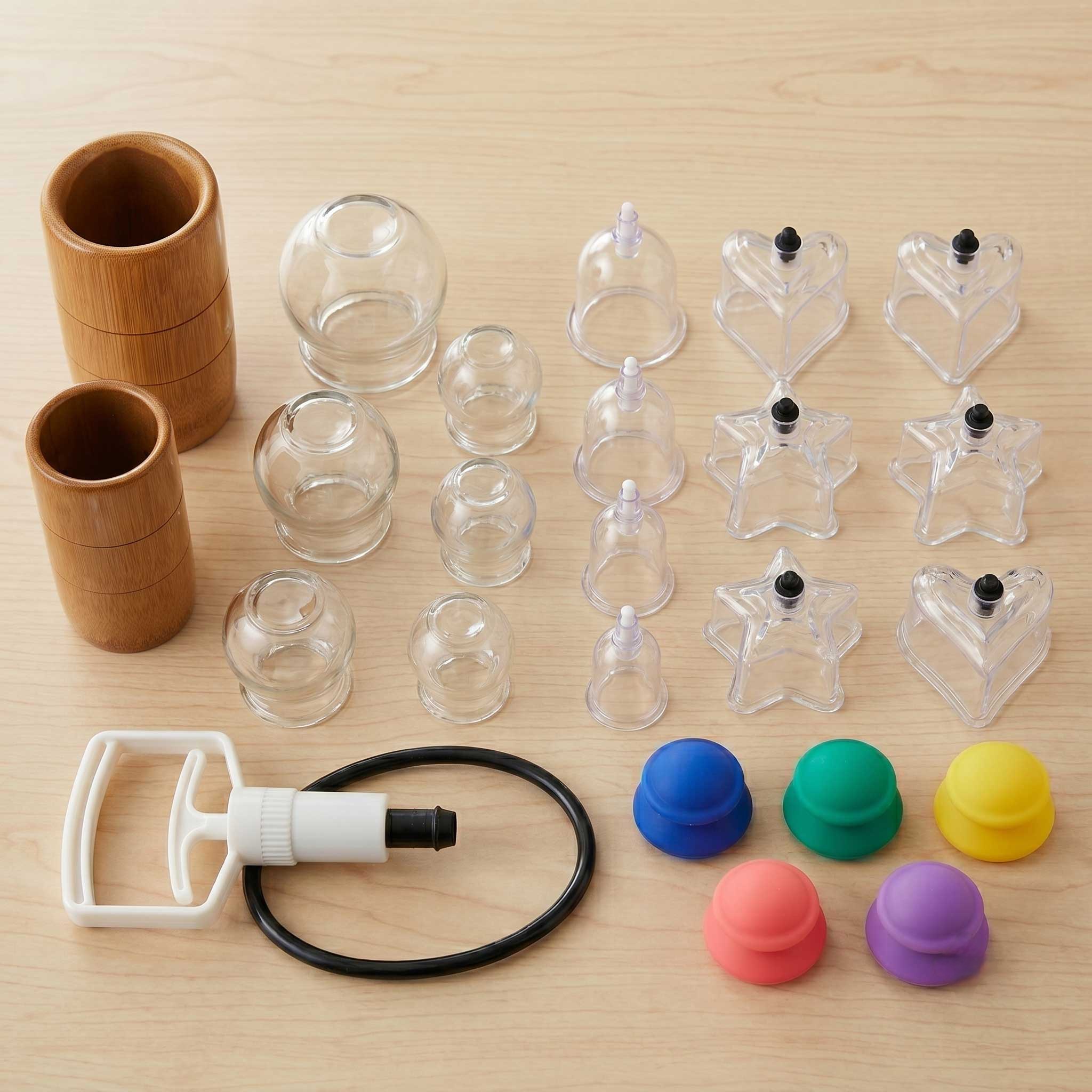
- Types of cups (silicone, glass, mechanical pump cups) and when to use each
- Skin and tissue response to vacuum therapy for athletes
- Basic anatomy review focused on athletic populations
- Contraindications, infection control, and clinical safety
Clinical Applications for Sports Settings
- Cupping protocols for common sites: hamstrings, calves, quads, shoulders, lower back, IT band
- Myofascial decompression certification for athletic trainers — full hands-on practice
- Combining cupping with stretching and mobility drills for faster results
- Pain management techniques using static and dynamic (moving) cupping
- Therapeutic cupping techniques for both acute soreness and chronic tightness
Injury Management & Recovery Protocols
- When cupping helps with sports injury recovery — and when it honestly doesn’t
- Building cupping into post-game and post-training recovery routines
- Fascial restriction treatment for chronic low back, neck, and IT band tightness
- Safety and contraindications — working alongside an athlete’s existing treatment plan
- Sports rehabilitation methods that combine cupping with progressive loading
Injury prevention strategies using soft tissue work before problems develop
Practical Application
- Live practice sessions with real-time feedback (offline batches)
- Case study walkthroughs for online students
- Documentation and client intake forms used in real clinical settings
- Recovery optimization planning — fitting cupping into a weekly athlete schedule
By the end, you’ll hold a certified cupping practitioner certification you can bring straight into your practice, clinic, or team setup — without needing expensive equipment beyond a basic cupping kit.
Who This Cupping Therapy Certification Is For
This cupping training course works well for:
- Athletic trainers wanting a sports cupping certification to round out their skill set
- Sports therapists and physical therapists looking for athletic trainer continuing education hours with a hands-on skill
- Strength and conditioning coaches who want a practical injury prevention strategy for their athletes
- Sports chiropractors and rehabilitation specialists adding soft tissue mobilization to their work
- Exercise physiologists and healthcare practitioners exploring evidence-based recovery methods
- Sports performance professionals building out athlete wellness programs
You don’t need a medical degree. You do need to be working with bodies in some way — training, treating, or coaching — because this course is built around real cases, not theory for its own sake.
Sports and Athlete Populations Covered
The course covers cupping applications across different sports and athlete types — because a marathon runner’s recovery needs aren’t the same as an MMA fighter’s.
Cricket players — shoulder, forearm, and lower back mobility concerns common after long bowling or batting sessions.
Football players — hamstring and quad recovery after matches and training blocks.
Marathon and distance runners — IT band, calf, and hip flexor recovery for repetitive movement demands.
CrossFit athletes — shoulder and thoracic mobility, plus soft tissue recovery after high-volume sessions.
Weightlifters — hip flexor and upper back mobility, plus post-training muscle recovery therapy.
MMA fighters — full-body recovery protocols between training sessions, especially for shoulders and hips.
Swimmers — shoulder and upper body mobility considerations specific to repetitive overhead loading.
Tennis and badminton players — rotational movement recovery strategies for elbow, shoulder, and lower back.
Knowing your athlete’s sport changes how you apply the cup. The course teaches you to think that way from day one.
Online vs Offline: Which Cupping Training Course Fits You?
We get asked this a lot. Here’s the honest comparison.
| Factor | Offline (Hyderabad, In-Person) | Online Cupping Certification |
|---|---|---|
| Best for | Hands-on learners, local trainers | Trainers outside India, busy schedules |
| Practical training | Live, supervised cup placement | Video demos + practical assessment |
| Time commitment | A few intensive days | Self-paced with assessment deadline |
| Feedback | Real-time, in-person | Recorded/Live review + Q&A support |
| Outcome | Certified hijama cupping practitioner certification | Certified hijama cupping practitioner certification |
| Good fit if you… | Learn by feel and direct correction | Need flexibility around work schedule |
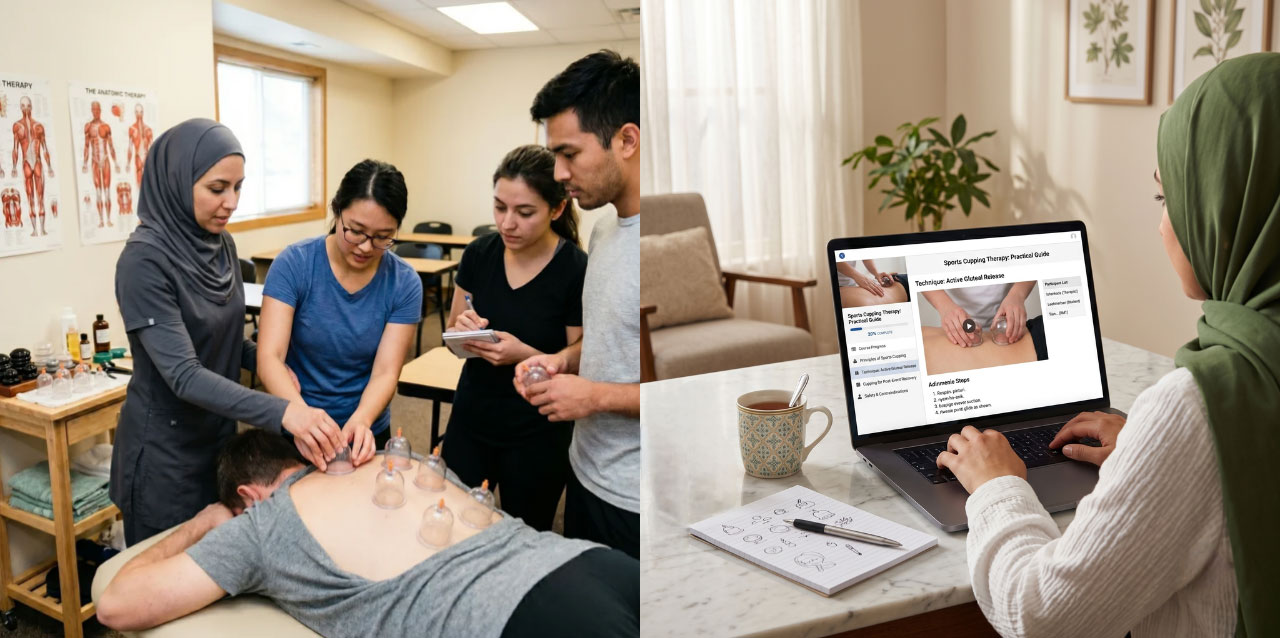
Offline: You get hands-on practice with feedback right away. If you learn better by doing — feeling the suction, watching skin response, adjusting cup placement in the moment — this is the better fit. Most athletic trainer batches prefer in-person because cupping is a tactile skill. Reading about it and doing it are very different experiences.
Online cupping certification for athletic trainers:
A solid option if you’re outside Hyderabad or India or juggling a packed schedule. You go through the same theory, clinical applications, and case studies, with video demonstrations and a practical assessment component. Many of our online students are working trainers studying sports therapy techniques between sessions.
Either path leads to the same certified cupping therapist outcome. The difference is just how you get there.
Serving Athletic Trainers Across Hyderabad India and Beyond
Students regularly attend our offline programs from across India — Hyderabad, Mumbai, New Delhi, Bengaluru, Ahmedabad, Kolkata, Chennai, Pune, Hyderabad, Gurugram, Surat, Jaipur, Vadodara, Nagpur, Lucknow, Visakhapatnam.
We also welcome sports medicine professionals from across India, neighboring countries like USA, UK, CANADA, MALAYSIA, UAE, SAUDI ARABIA , and more internationally for the online format.
Alhadiv Hijama Cupping Centre is Hyderabad’s specialist Hijama Cupping Centre with a focus on therapeutic applications — which means the training you get here is grounded in real clinical practice, not adapted from a generic wellness course.
What Students Say
★★★★★
“The practical sessions helped me start using cupping with athletes immediately.”
— Sports Therapist, Mumbai
★★★★★
“The myofascial decompression module alone was worth attending.”
— Strength Coach, Telangana
★★★★★
“I completed the online version and still felt fully supported.”
— Physical Therapist
A Real Story From the Clinic Floor
One of our practitioners told us about a physical therapist working with a semi-pro football team. She took our sports cupping certification course mainly to add something new to her sessions — not because she had a specific problem she was trying to solve.
Within a few weeks of integrating therapeutic cupping into athlete recovery sessions, players started specifically requesting “the hijama cupping thing” before away games. Not just because it felt good — but because their hamstrings genuinely felt looser the next day.
The interesting part wasn’t the cups.
It was the conversations that followed.
Athletes felt their recovery sessions were more personalized. That built trust. And that trust turned into consistent attendance.
Sometimes professional growth comes from adding one practical skill rather than chasing ten different certifications.
How Cupping Fits Into Sports Medicine and Rehabilitation
If you’re already in sports medicine, rehabilitation, or strength and conditioning — hijama cupping doesn’t replace your work. It fills a gap.
Think about it this way: stretching lengthens muscle. Strength work builds it. Hijama Cupping works on the layer in between — the fascia — that often gets completely skipped. For musculoskeletal rehabilitation, especially with athletes returning from soft tissue injuries, cupping can be a useful step between full rest and full training load.
Common applications covered in the sports cupping course:
- Post-surgery soft tissue recovery
- Chronic tightness that doesn’t respond to regular massage
- Pre-event cupping for mobility — lighter technique, different goal than post-event work
- Scar tissue and adhesion work for older injuries
- Accelerating recovery time between training blocks during competition-heavy periods
This is also where myofascial release therapy and cupping overlap. Both target the fascia — but cupping uses negative pressure (lift) instead of compression. Some athletes respond much better to the lift, especially in areas that feel “stuck” rather than just sore. In our experience, that distinction matters more than most trainers realize until they try it.
What Does Research Say About Sports Cupping?
While cupping therapy continues to be studied, researchers have explored its role in:
- – Range of motion
- – Pain perception
- – Soft tissue mobility
- – Recovery experiences
- – Myofascial decompression
Current evidence suggests hijama cupping support broader rehabilitation and recovery protocols when used alongside established sports medicine practices.
Students are encouraged to review current literature through PubMed, NCBI, and sports medicine journals.
How Cupping Compares to Other Recovery Modalities
| Modality | What It Targets | Where Cupping Fits In |
|---|---|---|
| Foam rolling | General muscle tension | Cupping reaches deeper fascial layers foam rollers can’t access |
| Massage gun | Surface muscle, blood flow | Cupping lifts tissue rather than compressing — different mechanism |
| Stretching | Muscle length, range of motion | Cupping can reduce tightness before stretching for better results |
| Manual therapy | Joint and soft tissue mobility | Cupping is often used alongside manual therapy, not instead of it |
| Ice/cold therapy | Inflammation, acute pain | Cupping is better suited for sub-acute and chronic recovery phases |
For trainers already trained in manual therapy certification programs, cupping is usually an easy add-on. The assessment skills overlap — the new piece is mainly the technique itself.
What Research Says About Hijama Cupping Therapy
We’re going to be straight with you here — cupping research is still growing, and we’d rather give you realistic expectations than oversell it.
Current research published through sources like PubMed, the National Center for Biotechnology Information (NCBI), the Journal of Athletic Training, and Sports Medicine Journal has investigated range of motion improvements, pain perception, soft tissue mobility, and myofascial decompression effects.
The evidence suggests hijama cupping is a useful part of broader rehabilitation and recovery protocols. It’s not a standalone cure. Most sports medicine professionals who use it do so as one component of a larger athlete care plan — which is exactly how we teach it.
We think that’s the right approach. Anyone selling you a cupping course by promising it’ll fix everything is not being honest about the literature.
How to Become a Certified Cupping Therapist at Alhadiv
- Enroll in the course — online or offline
- Complete the foundational education modules on cupping therapy and sports anatomy
- Learn sports cupping applications and myofascial decompression techniques
- Participate in practical training (live sessions or video assessment)
- Complete competency assessments
- Receive your certified cupping practitioner certification
- Start applying skills within your professional practice
This step-by-step path applies to both online and offline students.
What You’ll Walk Away With
| What You Get | Details |
|---|---|
| Certification | Certified cupping practitioner certification — structured for continuing education |
| Format | Online or offline (Hyderabad-based in-person batches) |
| Hands-on practice | Live sessions (offline) or case-based practical assessment (online) |
| Course focus | Sports medicine, myofascial decompression, injury recovery protocols |
| Who it’s for | Athletic trainers, physical therapists, strength coaches, rehab specialists |
| Take-home value | Protocols usable with your athletes the same week |
| Support | Instructor guidance and ongoing support post-certification |
Does Alhadiv Issue a Diploma Professional Certificate?
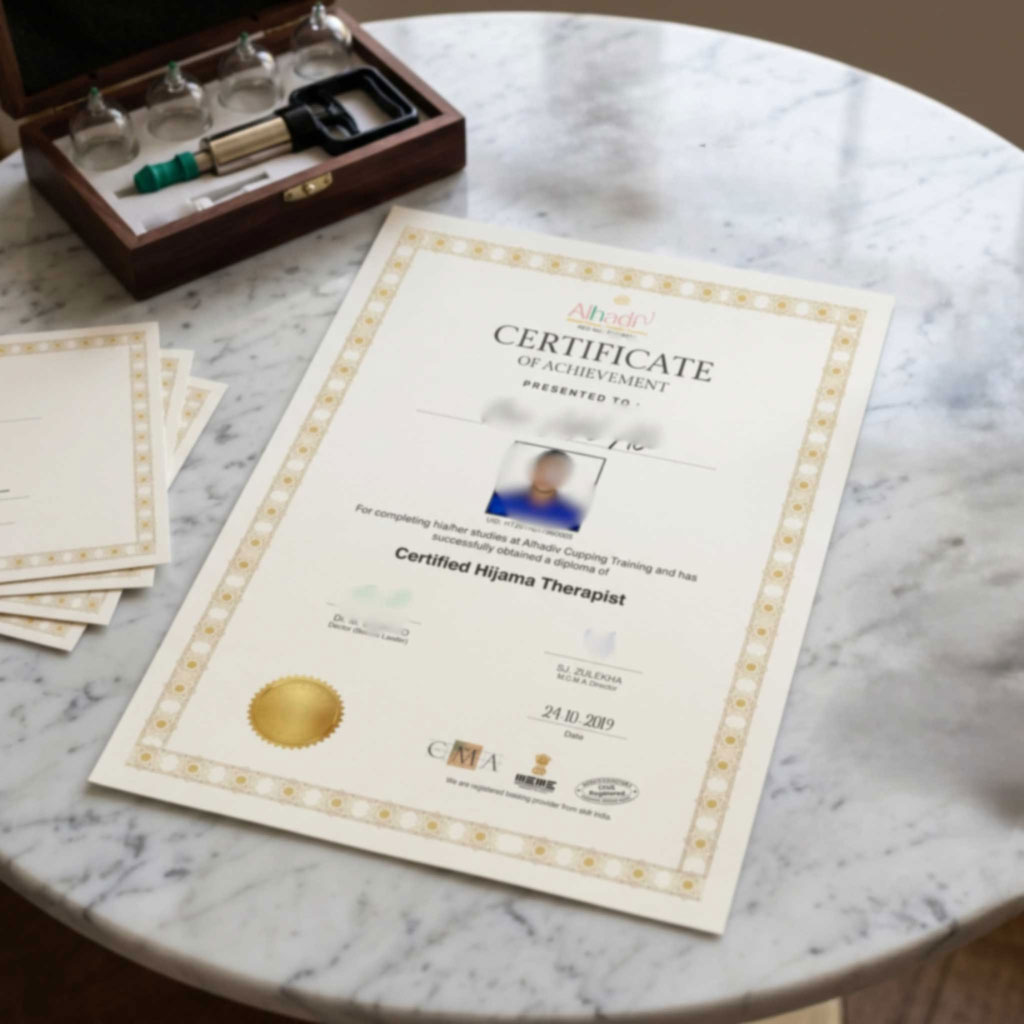
On successful completion of the program, students receive a certified Diploma certification from Alhadiv Hijama Centre Hyderabad.
If you’re looking for a sports cupping diploma or hijama diploma that reflects professional-level training — this certification documents your practical hours, clinical modules completed, and competency assessment outcomes. It’s designed to sit alongside existing professional credentials like ATC, PT, or CSCS — not replace them.
Meet Your Instructor [Dawood Ali]
- Certified Hijama Practitioner
- Sports Recovery Specialist
- 9 years clinical experience
- Trained 300 practitioners
- Special interest in athlete recovery and myofascial decompression
Training is delivered by experienced Hijama and cupping practitioners with practical experience in:
- – Athlete recovery
- – Myofascial decompression
- – Soft tissue therapy
- – Rehabilitation support
Students receive guidance based on real-world clinical applications rather than theory alone.
What Changes After Certification?
Many students report:
- Better athlete retention
- More recovery service bookings
- Greater confidence with soft tissue treatment
- Expanded treatment options
- Stronger referral relationships
Frequently Asked Questions — Cupping Certification For Athletic Trainers
Is this cupping certification For Athletic Trainers program recognized for continuing education credits?
The course is structured to count toward athletic trainer continuing education requirements. Check with your specific certifying body — credit recognition varies by state and organization. We're happy to provide course documentation to support that process.
Do I need prior massage or bodywork experience?
No, but it helps. If you're already comfortable working hands-on with athletes — taping, stretching, massage — you'll pick up cupping techniques faster. Complete beginners are welcome too, as long as you're working in a sports or rehab setting.
How long is the course?
Offline batches run over a few intensive days. Online courses are self-paced with a set practical assessment deadline. Contact us for current batch dates.
Can I use this for sports recovery certification alongside my existing credentials?
Yes. Most students layer this on top of existing credentials — ATC, PT, CSCS — as an additional recovery modality.
Is this the same as medical hijama?
Related, but different focus. Hijama traditionally includes wet cupping for broader wellness purposes. This program focuses on both wet, dry and therapeutic cupping techniques specifically for athletic and sports rehabilitation use.
Will I learn cupping for both pre-event and post-event recovery?
Yes — both are covered. Pre-event cupping focuses on mobility with lighter pressure. Post-event focuses on muscle recovery therapy and reducing soreness. Timing and technique are different for each, and the course covers both in detail.
Is this cupping certification for athletic trainers Courseonly for licensed professionals?
No. It's designed for anyone working with athletes in a professional capacity — trainers, coaches, therapists, and rehab specialists. You don't need a clinical license to enroll.
What equipment do I need?
Students learn about cup types, pumps, cleaning protocols, and clinical setup. Basic cupping kits are affordable and easy to source — we guide you on what to get.
Can cupping be combined with manual therapy?
Yes, and we recommend it. Many practitioners integrate cupping alongside manual therapy techniques for better soft tissue outcomes. The course covers how to sequence them.
What's the difference between sports cupping and traditional cupping?
Sports cupping focuses specifically on athletic recovery, movement quality, and rehabilitation. Traditional cupping covers broader wellness and therapeutic applications. This course is built around sports and rehab use cases.
Is there hands-on training?
Yes — for offline batches, hands-on supervised practice is a core part of the program. Online students complete video-based practical assessments with instructor feedback.
Can physical therapists take this course?
Yes. Many physical therapists attend our cupping therapy education programs specifically to add soft tissue decompression tools to their practice.
What sports injuries respond well to cupping?
The course covers hamstring strains, IT band syndrome, shoulder impingement, lower back tightness, calf tightness, and general soft tissue restrictions. Not every injury type responds the same way — the course teaches you how to assess and decide.
Is Hijama cupping therapy part of sports medicine?
It's increasingly becoming part of sports medicine practice. Many sports medicine professionals now use hijama cupping as one component of athlete recovery and rehabilitation programs rather than a standalone treatment.
Is this a beginner-friendly course?
Yes. Both beginners and experienced professionals attend. The course is structured to build from foundation concepts up to clinical applications.
Is hijama cupping therapy safe for athletes?
Yes. When performed by a trained practitioner, cupping therapy is generally safe for athletes and is commonly used to support recovery, mobility, and soft tissue health.
Does sports cupping leave marks?
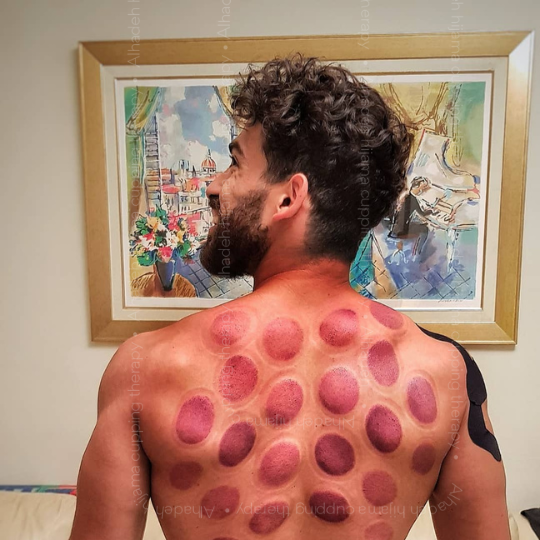
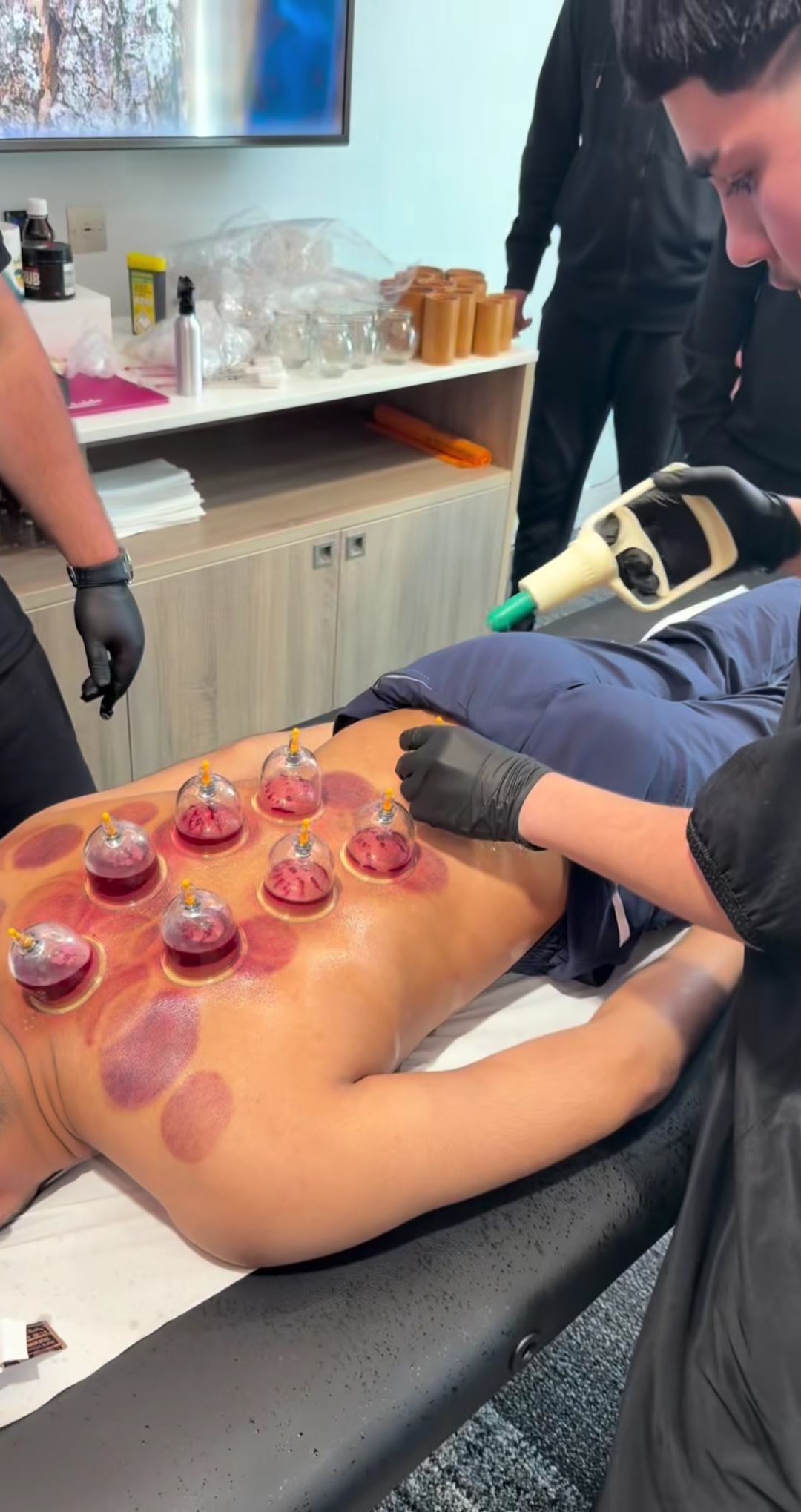
Yes. Sports cupping may leave temporary circular marks caused by suction and increased blood flow to the treated area.
How long do hijama cupping marks last?
Most cupping marks fade within a few days to two weeks, depending on the individual and treatment intensity.
Can strength coaches perform cupping?
Many strength and conditioning coaches complete sports cupping certification courses to expand their knowledge of athlete recovery and soft tissue techniques. However, regulations vary by location and professional scope of practice. Coaches should always follow local guidelines and work within the limits of their qualifications and certifications.
Is sports cupping evidence based?
Research on sports cupping continues to grow. Studies have explored its effects on pain perception, range of motion, soft tissue mobility, and recovery experiences. Current evidence supports its use as one tool within a complete athlete care strategy.
Not sure if this course is the right investment for your career? Read: Is Sports Cupping Certification Worth It for Athletic Trainers?
Is This Cupping Certification Accredited?
Alhadiv Hijama Centre’s cupping certification program is structured around professional clinical standards used in sports medicine and rehabilitation practice. The course is designed to meet continuing education requirements for athletic trainers, physical therapists, and sports medicine professionals.
We recommend checking with your specific certifying body — NATABOC, IAT, or your regional professional association — to confirm credit recognition, as accreditation requirements vary by country, state, and organization. We provide full course documentation to support any accreditation submission process.
If you’re searching for an accredited cupping certification or recognized hijama course for professional development, contact us directly and we’ll walk you through exactly what the certification covers and how it applies to your credential pathway.
Ready to Add Cupping to Your Practice and Become a Certified Therapist?
Athletes train hard. Recovery is what lets them keep doing it.
The trainers and therapists who understand recovery modalities, soft tissue therapy, injury management, and evidence-based recovery methods are the ones athletes come back to — and refer others to.
If you’re ready to develop real, usable skills in sports cupping, myofascial decompression, athlete recovery programs, and sports rehabilitation, Alhadiv Hijama Centre Hyderabad has both online and offline certification pathways built for today’s athletic trainers and sports medicine professionals.
Contact Alhadiv Hijama Centre Hyderabad today to reserve your place in an upcoming batch.

No Comments